
Why it matters
A project for Jæren must create value for Jæren.
The Dune is commercially ambitious, but its case cannot rest only on private hotel revenue. The project must demonstrate regional, public and environmental value in measurable terms.
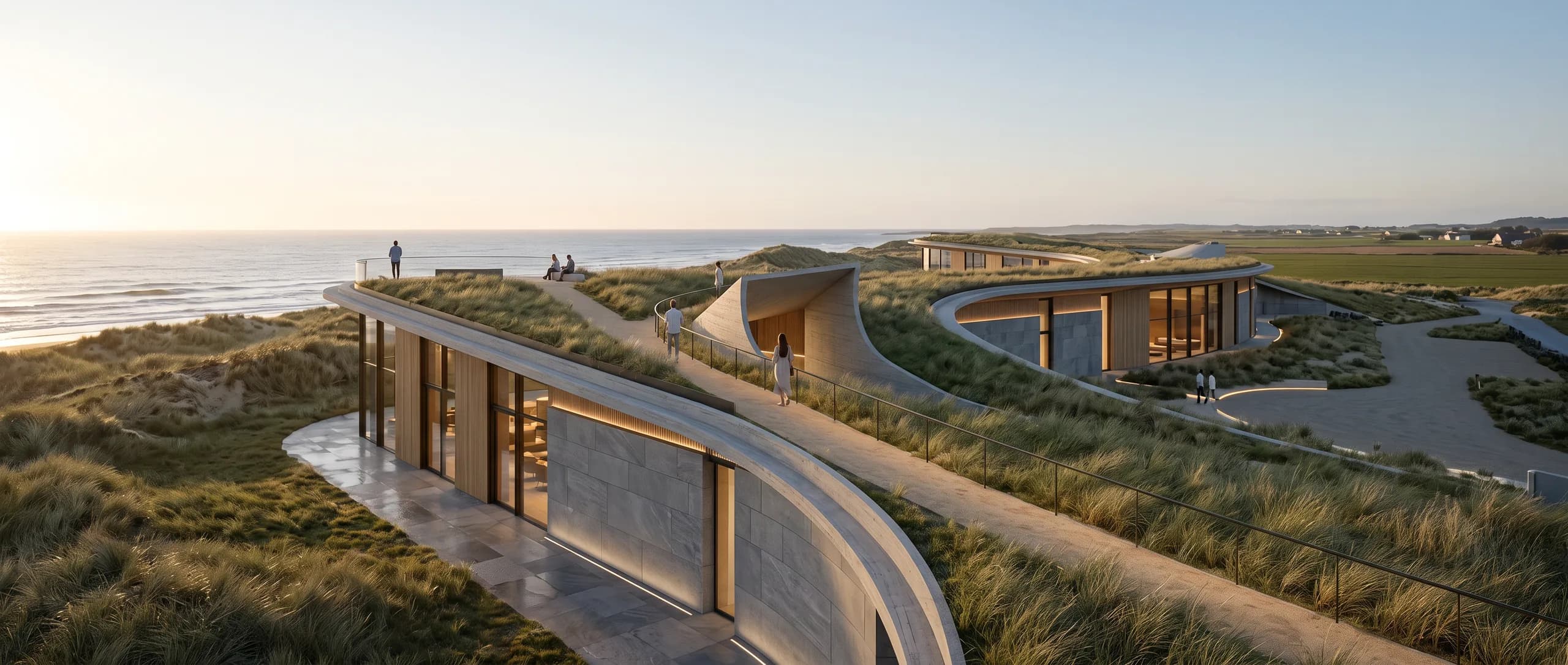
Early concept illustration, not a final design or planning proposal.
Architecture can change how a place is seen.
A signal building is not valuable simply because it is expensive or visually unusual. It becomes meaningful when it gives a region a shared image, attracts new audiences and creates activity around local identity.
The Dune aims to become a contemporary symbol of Jæren through a spatial idea people can experience: entering from farmland, gathering around The Heart and walking onto a roof that opens to the sea.
From stop to stay.
The Scenic Route, beaches, surfing, food and proximity to Stavanger already create visitor interest. The Dune could give guests a reason to remain on Jæren for several nights and experience the region through wellness, architecture, landscape and local food.
The target is not uncontrolled visitor volume. It is stronger value per stay, year-round demand and better connection between existing attractions and businesses, which is also the direction set by national tourism strategy.
Potential local value chains.
These benefits must later be tested in an independent regional-economic analysis.
- Hospitality and spa employment
- Local food purchasing
- Building materials and crafts
- Cleaning, maintenance and technical services
- Transport and guiding
- Wellness and treatment professionals
- Arts, culture and events
- Education, apprenticeships and research collaboration
Public access should be a designed system, not a promise in a rendering.
The project intends to preserve the public character of the beach and explore a publicly accessible landscape element through The Dune Roof. A credible public-access plan must define:
- Routes and hours
- Universal access
- Separation from private hotel areas
- Safety and weather closure
- Parking and public transport
- Nature protection
- Maintenance responsibility
- Whether access is free or connected to public facilities
“Integrated into nature” must be proven.
Green roofs and timber are not enough. Before baseline work exists, the project publishes the metrics it intends to be measured against rather than target numbers it cannot yet support.
- Hectares of sensitive habitat avoided
- Total land take, and share of existing developed land reused
- Embodied and operational carbon per m²
- Renewable and recovered heat share
- Water consumption, and stormwater retained or treated on site
- Biodiversity condition before and after
- Exterior-light limits and light pollution
- Transport mode share and transport emissions
- Local and regional procurement share
- Permanent and seasonal employment
The project will not claim zero impact.
A development of this scale in an open coastal landscape has consequences. The objective is to understand, reduce, mitigate and transparently account for impact, not to describe it away.
Where a measure cannot be secured contractually or through planning conditions, it will be presented as an intention rather than a commitment.
The hotel provides scale. The spa creates year-round depth.
The intended revenue model combines overnight accommodation with local and destination spa demand, memberships, treatments, food, retreats, meetings and selected celebrations.
This diversity can reduce reliance on summer room occupancy, but it also adds operating complexity and capital cost. The concept requires independent hotel and spa feasibility work before investment claims are published.
Every claim on this page needs evidence before it becomes a number.
The feasibility programme sets out what must be studied, in what order, and what could stop the project.