
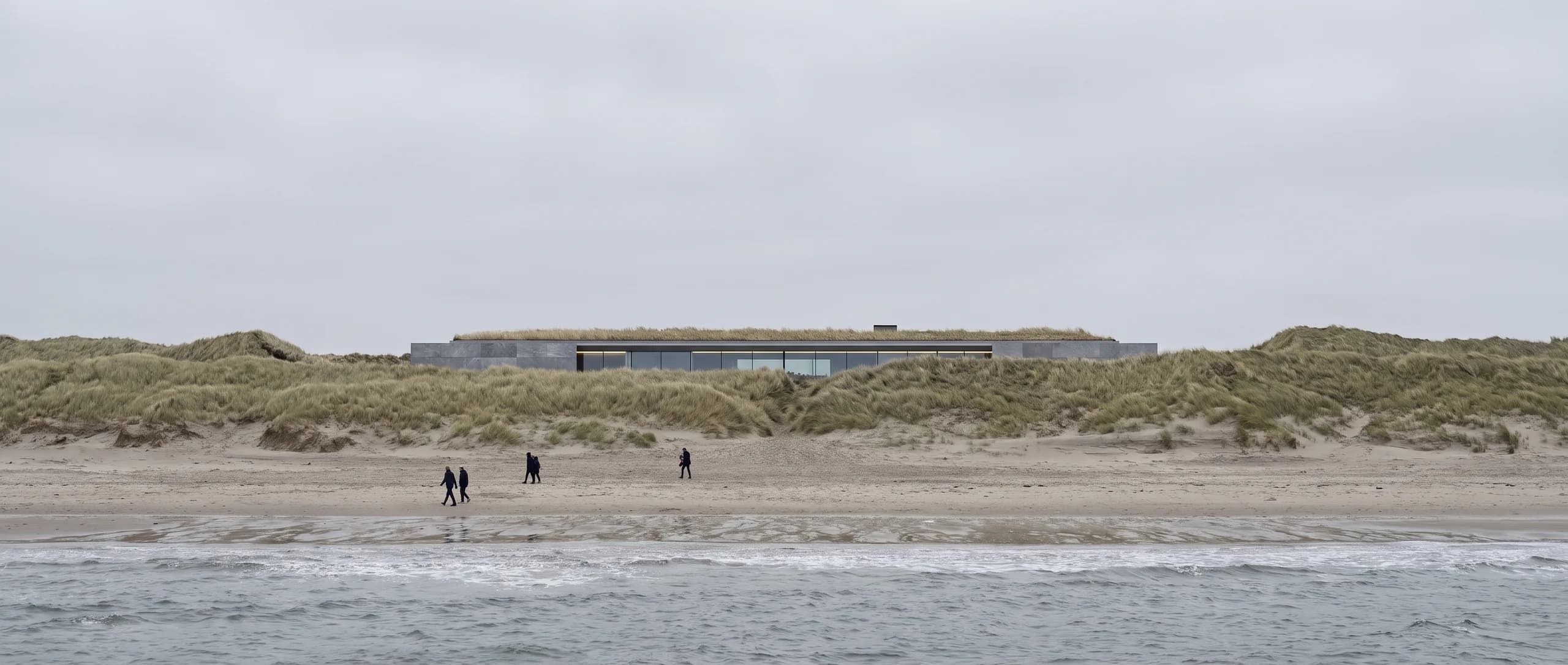
The next chapter for Borestranda
An ambition not yet completed.
The Dune is not introducing tourism to a place that has never considered it. Reporting from the early 2010s already described close to two decades of municipal work here, which places the ambition in the early 1990s, and makes it more than thirty years old today. A larger accommodation project was advanced here before. Understanding why it was never completed is the most useful thing this project inherits.
Early concept illustration, not a final design or planning proposal.
What the record shows.
Historical reporting from the early 2010s indicates that Klepp municipality had by then worked for close to two decades to facilitate a tourism development at Borestranda, and that a concept involving more than 110 guest rooms and a common service building of roughly 1,000 square metres was advanced in the area, supported by a land option and a tourism planning process. More than a decade has passed since that reporting, so the ambition now spans over thirty years.
That project was never realised as a single coherent hotel. Its financing depended on selling individual accommodation units in advance. When too few were committed, the scheme was reduced and restructured into individually owned cabins carrying rental obligations.
The weakness was not the destination idea. It was a fragmented financing and ownership model.
How the ambition moved.
- Klepp begins working to facilitate a visitor-oriented development at Borestranda. Reporting from the early 2010s describes close to two decades of effort by that point. Tourism here is a public planning intention, not a private notion.
- A destination-scale concept is advanced: more than 110 guest rooms in hotellhus, plus a common service building of roughly 1,000 m². Exact legal status requires archive confirmation.
- The financing model depends on advance sales of individual units and does not reach the commitments it needs.
- The project is reduced and reorganised around individually owned cabins with tourism-rental obligations, which preserves the tourism purpose but changes the physical and commercial nature of the place.
- Boretunet establishes accommodation, surfing, events and group experiences, creating an active local tourism hub.
- The Dune: one unified hotel, one destination spa, one architectural identity, proposed, and subject to a full modern planning process.
What exists today is a foundation, not a failure.
The cabins, Boretunet, the surf culture, the events and the local operators have built something real: proven demand, operational knowledge and a visitor economy that did not exist before. The Dune depends on that foundation and should be judged on whether it strengthens it.
What the area still lacks is a unified year-round hotel and wellness destination with the scale, service level and architectural identity to hold international attention, and a reason for high-value guests to stay several nights rather than pass through.
One place. One operation. One standard.
The distributed model
- Individually owned units
- Several design expressions
- Largely seasonal use
- Distributed guest experience
- Limited central wellness offering
- Property-sale-led financing
- Local tourism function
The Dune model
- Unified project and operating structure
- One architectural language
- Year-round hotel and wellness operation
- Curated arrival-to-departure journey
- Destination-scale spa
- Professional development and investment model
- Regional and international destination role
Build behind the dunes, not in them.
Recent planning history around Borestranda suggests that proposals meet stronger resistance as they move west toward the protected coast, and stronger acceptance when they sit inland or cluster near existing activity. The Dune treats that as a design rule rather than a constraint to negotiate.
Permanent buildings sit inland behind the protected dune systems. Arrival and servicing come from the east. Public beach access is maintained, there is no private beach and no fencing of the coastline, and views are created through orientation and topography rather than by building closer to the sea.
What this history does not establish.
It does not mean The Dune is approved, that Klepp supports it, or that the proposed location is buildable. It does not remove the shoreline rule, LNF restrictions, protected-dune boundaries or environmental-impact requirements, and it does not bind the municipality to anything.
Parts of Borestranda have an established planning history for tourism. The Dune will require an updated, evidence-based planning process on its own merits.
The archive request behind this page.
Complete file for Plan ID 8070
- What will be produced
- The full municipal file for Reiselivsanlegg på Borestranda: original plan initiative, description, provisions, maps, illustrative plan and current legal status.
- Why it matters
- Everything on this page currently rests on press reporting. Only the archive can establish what was formally approved as opposed to proposed.
Original hotel and service-building documentation
- What will be produced
- Site plans, floor plans, elevations, sections and visualisations for the earlier accommodation proposal, with neighbour notifications and public comments.
- Why it matters
- It would establish the real precedent for accommodation scale in the area, and what the objections actually were.
Statements from Statsforvaltaren and Rogaland county
- What will be produced
- Consultation responses and political case papers from the earlier process, plus documentation of the change from hotel to cabins.
- Why it matters
- The earlier objections are the best available guide to what a new proposal must answer.